The margins are where the thinking happens
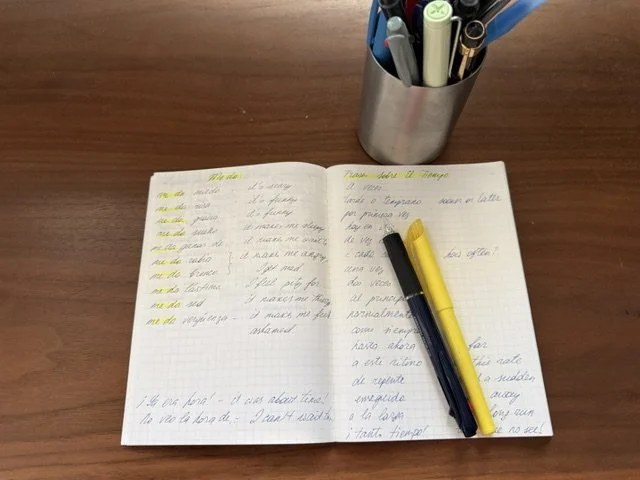
My current Spanish notebook
In college, in the early 1980s, I copied lectures by hand. There were no laptops, no phones. The most advanced students in the room had small cassette recorders, which they would set on the desk and then, presumably, never listen to again. The rest of us took notes by hand, but most people wrote in fragments — headings, a few underlined phrases, the occasional diagram. I copied everything, nearly word for word, page after page. My classmates thought it was excessive. One of them asked if I was planning to publish my notebooks. I wasn't. I just knew, even then, that nothing made it into my memory unless my hand had moved across paper to put it there.
Years later I did my MBA, by which point laptops were on every desk and my approach looked even stranger. I kept writing by hand anyway. I had tested the alternative enough times to know it didn't work for me. Recordings, typed notes, photographed slides — I could review them as often as I liked and feel nothing settle. The same material, copied by hand the first time around, would stay with me for years.
I'm trusting that instinct again now, at sixty-two, four years into learning Spanish. We've decided to move to Mexico eventually, and the language has become a daily practice rather than a hobby. I fill notebooks with conjugations, vocabulary lists, small sentences about the weather and the neighbors. The apps are faster. The notebooks are the ones that work. I've tried a Supernote, the electronic tablet that imitates the feel of writing on paper, and it gets closer than a keyboard ever could — but even it doesn't quite work the same way. Something about the actual paper, the actual ink, the small resistance of the pen, seems to be part of the mechanism.
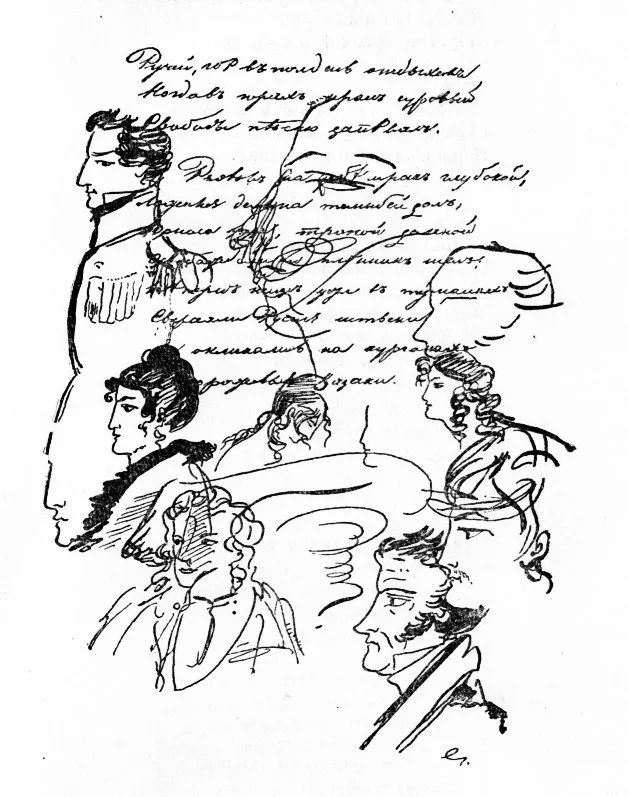
A page from one of Pushkin's notebooks, showing the sketches that filled his margins
There's a reason for this, apparently. Writing by hand is slower than typing, and the slowness is the point. The brain has to filter, compress, and decide what matters before the pen reaches the page. Typing lets you transcribe without thinking; handwriting forces a small act of translation. The motor memory of forming each letter seems to lay down a second track alongside the meaning, so the idea has two places to live instead of one.
This same instinct, I think, is what draws certain readers to write in the margins of their books. A pencil in the hand turns reading from reception into conversation. You argue, you underline, you draw an arrow from page 47 back to something on page 12. You leave a question for yourself to answer on a second read.
Pushkin's books are the example I return to. His margins are full of life: not just notes and corrections but quick sketches of faces, profiles, horses, hands, sometimes the people he was thinking about while reading. He drew Byron in the margin of a Byron volume. He drew himself. His annotations don't read like a scholar's; they read like someone in the middle of a fast, private conversation with the book, leaving evidence of his mood as much as his thought. You can almost see him at the desk.
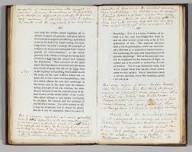
Coleridge's own copy of Sibylline Leaves, annotated in his hand
Coleridge took the practice so seriously that he coined the word marginalia for it. He filled other people's books with such substantial commentary that friends would lend him volumes hoping to get them back annotated. Some of his marginal notes were later published as their own works. The margin was, for him, a legitimate place to think, not a defacement of the page.
What both of them understood is something a highlighter on a screen can't reproduce. A line of yellow over a sentence says only this caught my attention. A note in the margin says here is what I thought, on this day, at this age, before I knew what came next. Years later you open the book and find a younger version of yourself there, arguing with a passage you now agree with, or agreeing with one you've since outgrown. The book becomes a record of two readings at once.
My own books are marked up in pencil, lightly, because I was raised not to write in books and the rule still tugs at me. But the pencil is enough. When I pull a book off the shelf years later, the underlines and the small notes are what I read first. They tell me where I was when I read it, what I was looking for, and sometimes — embarrassingly, usefully — how much I've changed.