Reading the Odyssey Again, This Time in Wilson's English
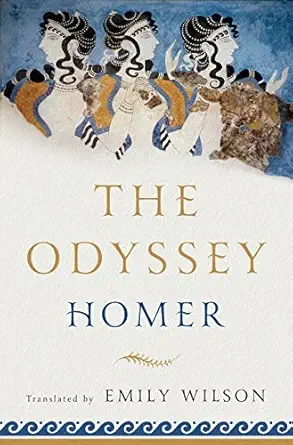
Homer, The Odyssey, translated by Emily Wilson. W. W. Norton, 2017.
After I wrote about the heroes of the Iliad, a friend asked whether I had read Emily Wilson's new translation of the Odyssey. I had not. Wilson published her Odyssey in 2017, and her Iliad followed in 2023. She is the first woman to translate either poem into English in any complete sense. I picked up the Odyssey first, because the Odyssey is the one I was rougher on in the previous post.
Coming to Wilson from the Russian
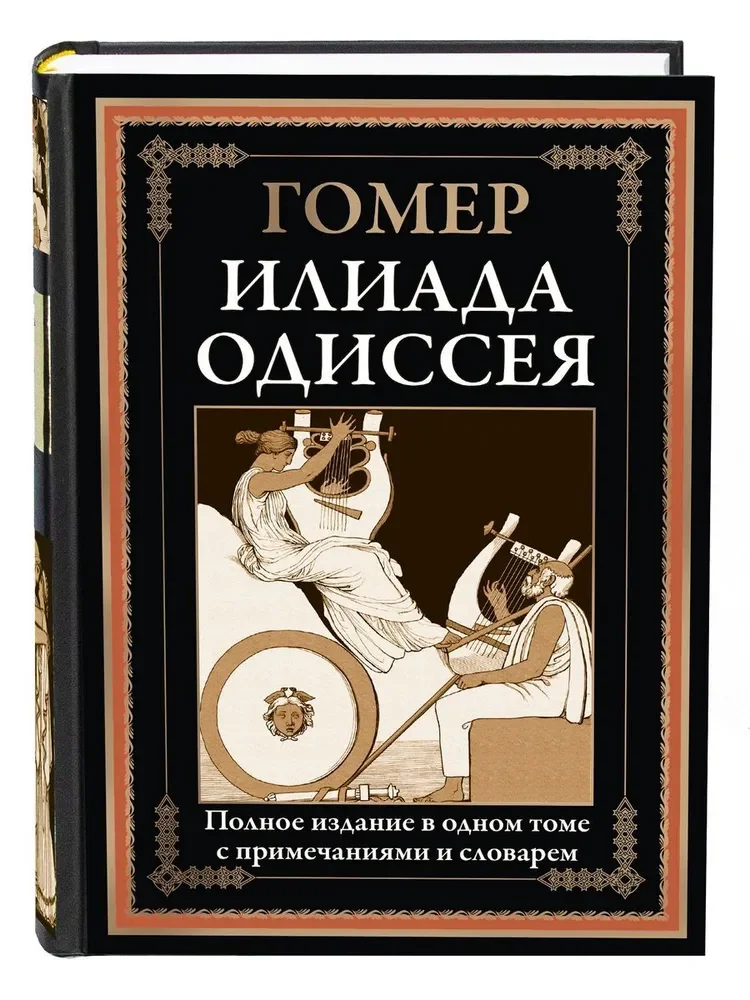
Гомер, Илиада. Одиссея. Translated by Nikolai Gnedich and Vasily Zhukovsky. Eksmo, Moscow, full edition with notes and glossary.
The reading was harder than I expected. English is not my first language, and the classics I love I love through Russian: Gnedich's Iliad from 1829, Zhukovsky's Odyssey from 1849. These translations are themselves monuments. I came to them as a child the way other children come to fairy tales. Their hexameter rolls. Their vocabulary is elevated, almost liturgical. When I think of Homer in any language, I hear Zhukovsky's cadence first.
Wilson is not that. Wilson is in iambic pentameter, the meter of English blank verse, and her diction is plain. Her famous opening line is five words: "Tell me about a complicated man." I read it the first time and felt nothing, which I think is the point. There is no aura, no halo, no Muse-summoned hush. Just a sentence. The aura I had carried for decades was something the translators put there, not something Homer put there.
Polytropos, and the choice every translator makes
Zhukovsky opens his Odyssey: Муза, скажи мне о том многоопытном муже, который… "Muse, tell me of that much-experienced man, who…" The Greek word both are wrestling with is polytropos, literally "many-turned" or "many-turning." It is ambiguous on purpose. Is Odysseus the one doing the turning, twisting his way through obstacles with cunning? Or is he the one being turned, tossed around by the gods? The word holds both. Zhukovsky chose многоопытный, "of much experience." Wilson chose "complicated." One word gives you a wise traveler before the poem has even started. The other gives you a warning.
I had never noticed this before. I had read Zhukovsky's word as straightforwardly accurate, the way you read a word you grew up with. Wilson's word made me look back at the Russian and see what was missing in it. Многоопытный is noble. It is a word you would carve on a bust. There is no doubt in it, no agency problem, no moral ambiguity. Reading Wilson, I understood for the first time that Zhukovsky had made a choice. Every translator makes a choice. The choice the male translators kept making, in Russian and in English both, was to give Odysseus the benefit of every doubt.
The portrait that bought a man's freedom
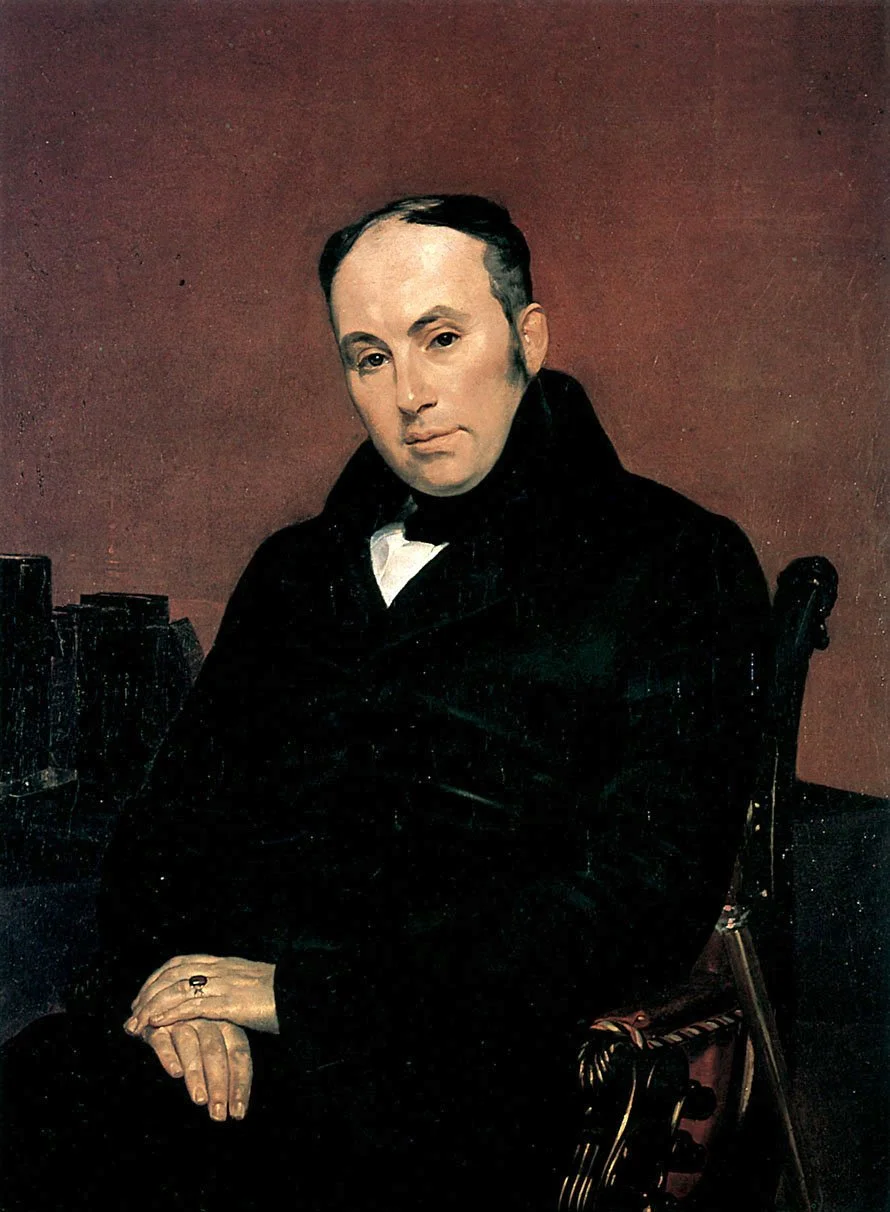
Karl Bryullov, Portrait of V. A. Zhukovsky, 1837–38. Tretyakov Gallery, Moscow. Raffled in a private lottery in April 1838; the 2,500 rubles paid for the winning ticket bought Taras Shevchenko out of serfdom.
The portrait of Zhukovsky I keep coming back to was painted by Karl Bryullov in 1837. The poet in his dark coat, hand folded over hand, a Petersburg interior behind him. The painting has a strange afterlife. Bryullov and Zhukovsky raffled it off in a private lottery in April 1838, after months of negotiating with a reluctant landowner named Engelhardt. The winning ticket was held by the wife of Tsar Nicholas I. The two thousand five hundred rubles paid for the portrait bought the Ukrainian poet Taras Shevchenko out of serfdom on April 22, 1838. A portrait of a Russian translator, used to ransom a man out of slavery. I find I cannot look at it without thinking of the women in the Odyssey he was about to translate.
Slaves, maids, and the word that slips
In the original Greek, the women who serve Penelope in Odysseus's absence are dmōai, female house-slaves. The word means what it means. The English tradition has called them maids, servants, handmaidens, anything softer than slaves. Wilson calls them slaves. When Odysseus comes home and orders the twelve of them hanged for sleeping with the suitors, Wilson calls them girls. Her translation does not let you misread the scene as a household punishment. It is the murder of enslaved young women who had no choice about whose bed they were called to.
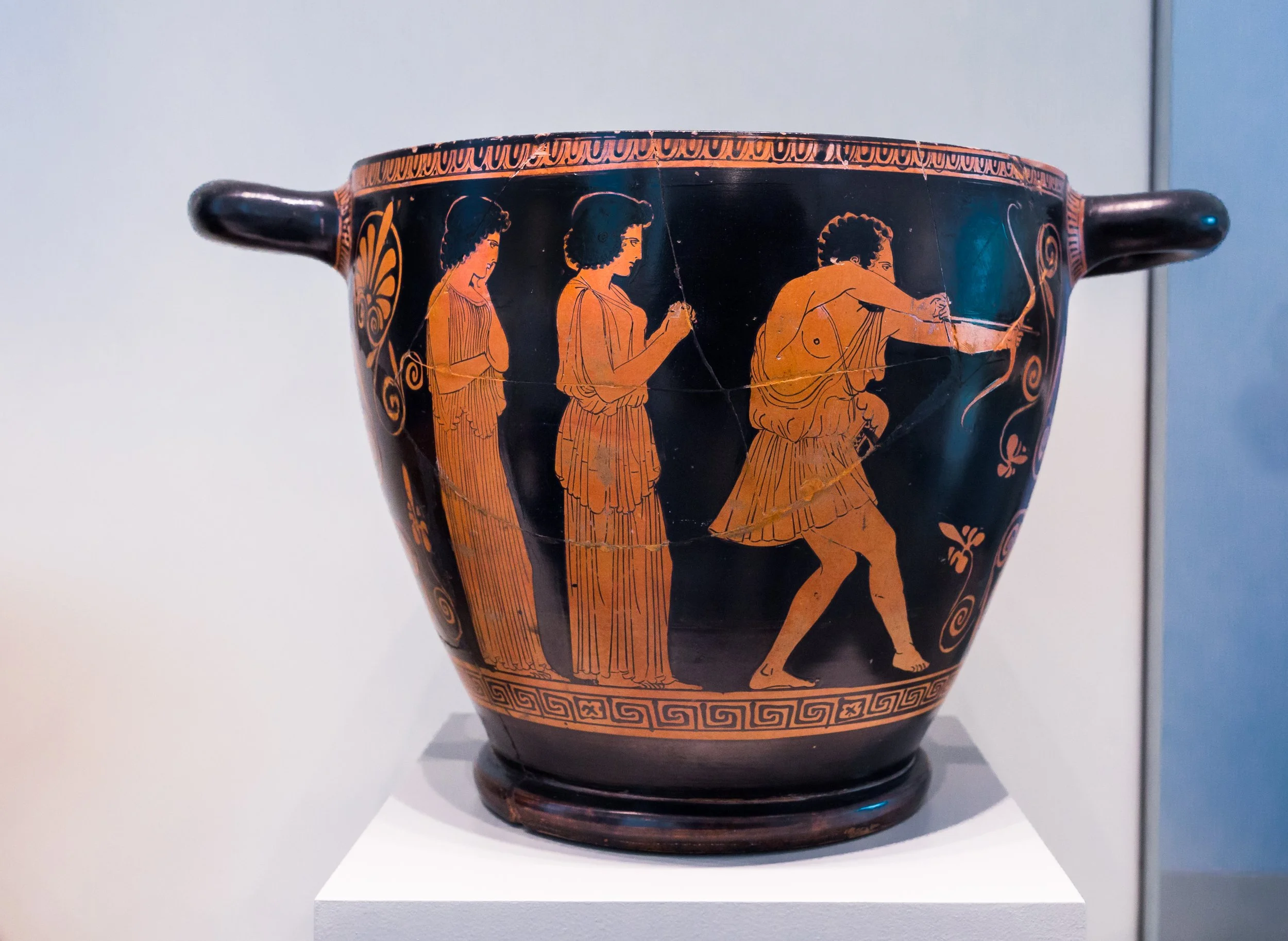
Attic red-figure skyphos, the Penelope Painter, c. 440 BCE. Odysseus draws his bow; two women stand by, unnamed. Altes Museum, Berlin (F 2588).
Zhukovsky is partly better here, partly the same. He uses рабыни, "slave women," in places where the English tradition softened to "maids." In other places he slides to служанки, "servant girls," especially around Penelope, where the household context softens the word's edge. The chapter summary for Book 22 in the standard Russian edition calls the hanging Казнь рабынь, "Execution of the Slave Women," which is closer to the bone than any English translation I know of before Wilson. So I want to be fair: the Russian was less euphemistic than the English. It was not honest either. The word slips around depending on whose comfort the translator was protecting in that particular passage.
The meter you cannot rest your reverence on
Meter is harder to argue about because it is felt rather than reasoned. Zhukovsky and Gnedich both wrote in Russian hexameter, six-foot lines, dactylic, attempting to imitate the Greek. Russian hexameter has a slow swell to it. The lines run long. There are many unstressed syllables between the stresses, so each line feels suspended, ceremonial, like a procession passing. It is gorgeous. It is also distancing. The story happens at the far end of a long room, lit by candles, told by a voice that knows it is telling a sacred thing.
Wilson's iambic pentameter does the opposite. The line is shorter. The stresses come closer together. The poem moves at conversation speed. When Odysseus does something cruel, the cruelty arrives in a normal sentence at a normal pace, and you cannot drape your reverence over it the way Russian hexameter lets you. The reading is harder, partly because of my English, but partly because the meter does not give you any place to rest your reverence.
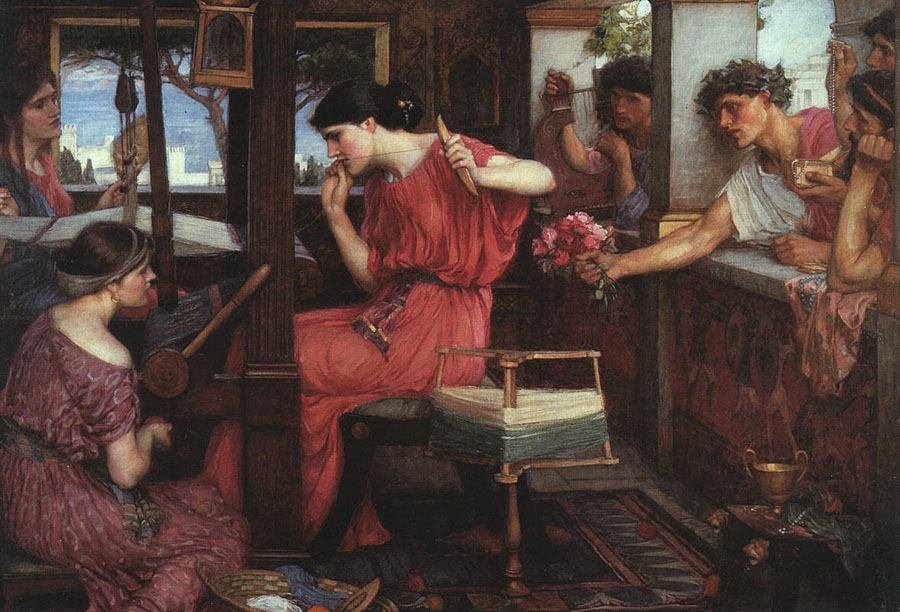
John William Waterhouse, Penelope and the Suitors, 1912. Aberdeen Art Gallery.
What this does to Hector
So what does this do to the question I asked in the previous post?
It sharpens it. Odysseus the noble sufferer, the symbol of wit and cunning, the loving husband and devoted son, the great warrior, the wandering man brought low by fate, is partly an artifact of translation. He is what two centuries of male translators decided to make of him, in Russian and in English both. The Greek text is harsher. Wilson did not invent the cruelty. She declined to euphemize it. Reading her, I find the case I made for Hector strengthening, not weakening. Hector's greatness survives any honest translation. Odysseus's does not, quite. The closer you get to the Greek, the more complicated he becomes, which is exactly the word Wilson chose for him.
I am glad I read it. I am also glad I read it after Zhukovsky and not before. Wilson does not replace Zhukovsky for me. She corrects him in places, and she shows me what his choices were, which I could not see from inside Russian alone. The wabi-sabi of it is that there is no perfect Homer. Every translation is a hand laid on the text. The best you can do is read more than one hand, and notice where the hands disagree.
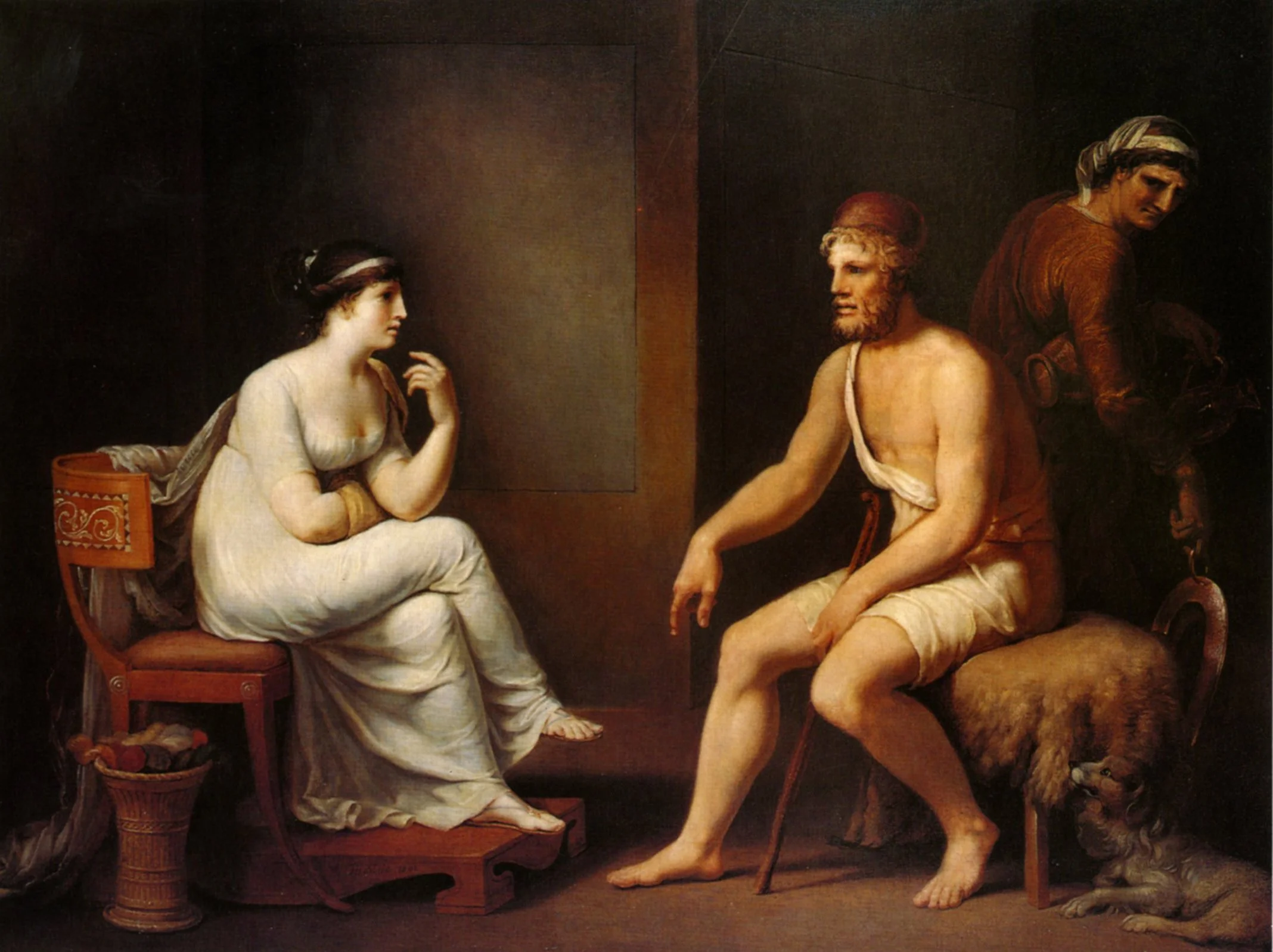
Johann Heinrich Wilhelm Tischbein, Odysseus and Penelope, 1802. Private collection.
If you have a favorite translation of the Odyssey, in any language, I would love to know which one and why. And if you have read Wilson, tell me whether your Odysseus changed.After I wrote about the heroes of the Iliad, a friend asked whether I had read Emily Wilson's new translation of the Odyssey. I had not. Wilson published her Odyssey in 2017, and her Iliad followed in 2023. She is the first woman to translate either poem into English in any complete sense. I picked up the Odyssey first, because the Odyssey is the one I was rougher on in the previous post.